Showing posts with label Historical. Show all posts

Tuesday, August 22, 2023

Masai Betrothal Enkarewa

Beaded wedding necklace 

 
This is a Massai beaded marriage necklace known as the Enkarewa. It is made with glass beads, tough Manila strings and animal skin. This necklace is said to be the traditional Massai wedding necklace that is worn by the brides.The Enkarewa is bride necklace that is a symbol that a girl is transitioning to womanhood as she is about to form her own family. 

The enkarewa is passed down to through generations as heirloom. The colors and designs on it serve as certain aspects of the brides journey from innocence to maturity and indicating ties of where she belongs within the community. The necklace is a symbol of two family connecting as one through marriage.


The Enkarewa is a symbol in Masai culture, representing the transition of a girl into womanhood as she prepares to form her own family. The necklace serves as a profound symbol of the union of two families, coming together as one through the sacred institution of marriage.

Glass beads, Manila strings and animal skin (used as the necklace's base, enhancing its overall structure and design).

Beading, stringing( beads are meticulously threaded onto the tough Manila strings), knotting and closure ( mechanism enabling the bride to easily wear and remove the necklace!


Monday, August 21, 2023

Ancient Egypt (Crown)


Diadem of Tutankhamen 

This is king Tutankhamen crown. He was a pharaoh that ruled in the 18th dynasty in ancient Egypt. Egyptian Pharaohs wore crowns  made of gold in which gold was a symbol of  elevated status and intermediaries between the gods and people.played part in indicating the pharaohs status and the highest authority in the kingdom.

Gold and gemstones( red carnelian , blue and green, lapis lazuli,black obsidian and glass). The technique used was hammering, setting, granulation and soldering.


King Tutankhamun, a pharaoh of the 18th Dynasty in ancient Egypt, wore a crown as a symbol of his elevated status and his role as an intermediary between the gods and the people. Egyptian pharaohs frequently adorned themselves with crowns made of gold, signifying their highest authority in the kingdom.

Gold and gemstones( red carnelian , blue and green, lapis lazuli, black obsidian and glass). The technique used was hammering, setting, granulation and soldering.The technique used was hammering, setting, granulation and soldering.

isicholo (Traditional Zulu HatUsed By The Shembe)

 
Zulu beaded hat

This is a Zulu hat known as Isicholo. It is traditionally and religiously worn by Zulu women. The Shembe women wear it as part of their uniform to signify their marital status and to show respect to their husbands and family as the head is said to be sacred therefore if one is married their head should not be seen.

It is made using non-plant fibre , cloth (to strengthen the brim) and glass beads. Some have a reddish hue made of ochre and fat mixture colourant. 

Techniques used are weaving, braiding , dyeing , stitching beading and trimming.

Isicholo is a traditional Zulu hat, known for its circular shape with a wide brim. It is a significant cultural symbol among the Zulu people of South Africa, and it serves various purposes:

Materials: The construction of Isicholo involves the use of natural materials, and the specific materials can vary:

  • Grass: Various types of grass, such as ilala palm leaves, are commonly used to create the base of the hat. The grass is often woven or braided into the circular shape of the hat's crown.
  • Reeds: Reeds are another natural material that can be used to construct Isicholo hats. They are often soaked in water to make them pliable and then woven into the desired shape.
  • Plant Fibers: Fibers from various plants can be used to strengthen the hat's structure or for decorative purposes.
  • Cloth: In some variations of Isicholo, cloth material is used to cover the hat's base. This cloth is stitched onto the hat's structure.
  • Beads: Glass beads are used for decoration, meticulously stitched onto the hat's surface to create intricate and culturally significant patterns.

Techniques: The creation of Isicholo hats involves several techniques that have been passed down through generations:

  1. Weaving: Weaving is a fundamental technique used to create the crown of the hat. Various natural materials, such as grass, reeds, or palm leaves, are woven together to form the circular shape of the hat's crown.

  2. Braiding: Braiding techniques are often employed in creating the base or framework of the hat. Thin strands of plant fibers are braided together to add strength and flexibility to the structure.

  3. Dyeing: If the hat is to have colored elements, such as a red hue on top, natural dyeing techniques are used. Plant-based dyes may be made from sources like roots, leaves, or berries to achieve the desired color.

  4. Stitching: In some variations of Isicholo, cloth material is used to cover the hat's base. Stitching is employed to attach the cloth to the hat's structure securely. This can also include the addition of decorative stitches or patterns.

  5. Beadwork: Beadwork is a crucial technique for decorating Isicholo hats. Glass beads are meticulously stitched onto the hat's surface to create intricate and culturally significant patterns. These patterns often convey stories, symbols, or traditional motifs.

  6. Trimming and Finishing: After the main construction and decoration, the hat may undergo trimming and finishing touches. This can involve cutting excess material, ensuring that the hat's brim is even, and adding final embellishments if needed.

These techniques showcase the craftsmanship and artistry of Zulu culture, preserving the tradition and cultural significance of Isicholo hats.


https://www.si.edu/object/nmafa_2001-6-2
https://tribalnow.wordpress.com/2019/09/02/isicholo-hats-zulu-people-kwazulu-natal/
https://www.artic.edu/artworks/229886/woman-s-hat-isicholo

Traditional Zulu Necklace

Beaded Zulu Necklace


This is a Zulu beaded necklace. It is worn by the Zulu women and men it is used as adornment and has different meanings to them. It is made using glass and shell beads.

The patterns and colours used on the Zulu beadwork is sort of used as communication among people to understand one another without having to ask as the beadwork and colors do send the message to the reader or observer to understand one's status. The main shape used on the AmaZulu beadwork is the triangle. It is used to indicate one's gender and marital status. When the triangle is pointed upward it represents a woman and when pointed down it represents a man. In this case, wearing this necklace shows your marital status hence wearing a necklace with a diamond shape indicates that you are some fiance or you are married.


This is a Zulu beaded necklace, it is a cultural adornment with communication embedded in its patterns and colors. It is worn by both Zulu women and men, the triangle shape serving as a key symbol indicating gender and marital status. These necklaces are more than just jewelry; they are a vibrant form of silent expression within the Zulu community.

Glass beads, plant fibres ( nylon or cotton). Technique used is beading, stringing and closure (catch).

https://zulubeadculture.weebly.com/symbols-and-meanings.html

https://paintexpert.co.za/the-colour-meanings-of-a-zulu-love-letter/

 https://thegrace.co.za/traditional-beads/ 

Saturday, June 10, 2023

Jewish Amulet (Lilith pandent)

Engraved Silver Lilith Pendant

The above image shows a baby amulet etched with biblical verses and kabbalistic formulas that list the Bible and the name of god is engraved on it and the image of  Lilith. This amulet, known as a kameya in Hebrew, is an illustration of the widespread and age-old Jewish custom of protecting newborn children from Lilith's wrath and the evil eye. Lilith is viewed as a strong and envious energy that babies are easily harmed by. The amulets could be worn around the neck or attached on strings. 

This amulet serves as a protective talisman, intended to safeguard newborn children and women during childbirth by warding off the influence of Lilith, a nocturnal demon. The pendant incorporates biblical quotations and Kabbalistic formulas and quotation from Leviticus 6:22-24 and incorporates it into an inscription that complements the text of the Priestly Blessing from Leviticus 25-27, enriching its spiritual symbolism.with the letters of the "name of God" adds to the amulet's mystical significance, underscoring its protective purpose.

It is crafted in silver and takes the form of a rectangular cut-sheet with a distinctive peaked top. The centerpiece of the amulet features a central human figure, symbolizing Lilith, surrounded by intricate Hebrew inscriptions.


  • The amulet is primarily made of silver.the technique used for this amulet was engraving


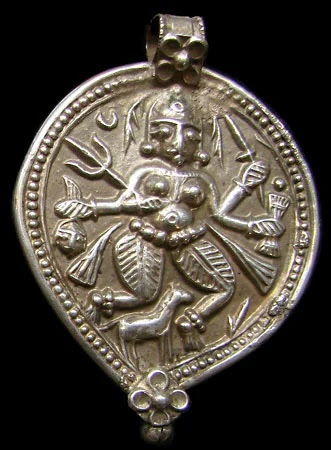
Hindu Amulets

Brass Durga Pendant

Durga is a Hindu goddess she is used as an Amulet that  is connected to defense, power, motherhood, devastation, and conflicts.
As a symbol of achieving of good over evil, Durga's narrative is centered on battling evils and demonic powers that imperil  prosperity and peace. It is thought that Durga unleashes her divine fury on the wicked in order to free the oppressed, and that she involves devastation in order to strengthen creation. Durga is revered as a motherly goddess and frequently portrayed as a stunning woman riding a lion or tiger, holding weapons in each of her many arms, and frequently vanquishing demons.

The Durga amulet, a revered symbol in Hinduism, depicts Goddess Durga riding a lion and wielding weapons. In Hindu mythology, armed with these weapons, Durga battled and defeated the powerful demon Mahishasura and his army, symbolizing her protective nature. The amulet serves as a shield, protecting the wearer from negative energies and adversities, invoking the strength and fearlessness of Goddess Durga.

Material used is silver


Monday, June 5, 2023

Roman Amulet

Etruscan gold bulla amulet

A bulla amulet is a neck chain and round pouch locket made of gold or covered in a gold foil. It is worn around the neck as a locket containing protective amulets like phallic symbols to protect against evil forces. It is given to a baby boy nine days after birth and freeborn males wore it until they came of age. Before he puts his Greco Romania garment of manhood(Taga virilis) and places his boyhood bulla in the care of his parents house.

The Roman bulla is a round amulet worn by boys to ward off evil spirits. It consists of two convex plates and is typically given to a boy eight days after his birth, coinciding with the day he is named. It also symbolizes the status of being a freeborn child.

Materials: The materials used to craft a Roman bulla varied depending on the family's status:

  • Silver, Gold, or Bronze: Bullae made of precious metals like silver or gold were reserved for high-status families. These bullae were likely more ornate and luxurious in design.
  • Bronze: Less expensive bullae were made from bronze, which was a more accessible material. They would still provide protection but were less extravagant.
  • Leather: In some cases, bullae could be crafted from leather, especially for families with more modest means. Leather bullae were simpler in design but served the same protective purpose.

The Roman tradition of wearing bullae was influenced by the Etruscans, and it played a significant role in the cultural practices surrounding the birth and naming of children in ancient Rome.


Monday, May 22, 2023

Egyptian Necklace Amulet

Heavy beaded neck piece with with a crescent front  

 
In ancient region, the Menat is an amulet that has many rows of beads and a cresent font piece and a counterpoise attached at it rear. The necklace was intended to bring good fortune and protect against evil spirits. It was also worn for afterlife protection and is frequently discovered buried with the dead, given as a grave gift from Ramesside times (the second Dynasty of the Ancient Egyptian New Kingdom period, lasting from 1292 BC to 1189 BC.)Females who engaged in religious activities were more likely to carry it.  It was a percussion instrument that was shook to provide a soothing noise in order to satisfy a god or goddess. The other end of the strings were attached to a counterweight that was hung from the wearer's back. The aegis was often made of faience(keyhole-shaped piece) and other materials like leather and metal such as bronze were also used.

The Menat, an ancient amulet, consists of multiple rows of beads, a crescent-shaped pendant in the front, and a counterpoise at the rear. This necklace served various purposes, including bringing good fortune, warding off evil spirits, and providing afterlife protection. It was frequently discovered as a burial offering during the Ramesside period of Ancient Egypt (1292 BC to 1189 BC). Women engaged in religious activities often wore it, and it also functioned as a percussion instrument used to produce soothing sounds for divine offerings.

The Menat was crafted using different materials, with the beads typically made of faience. Additional materials such as leather and metals like bronze were also used. The amulet was meticulously strung together with multiple rows of beads and attached to a counterweight at the rear, allowing it to be worn comfortably. This technique ensured its durability and effectiveness in both spiritual rituals and protective functions.


Thursday, May 18, 2023

Ancient Egyptian (Ankh)


Egyptian Ankh 

In Ancient Egypt, the ankh symbol is refed to as the key of life or the key of the Nile it represented endless life. The ankh, which was created by Africans in ancient Egypt and is thought to be the first or original cross. The ankh is frequently depicted in the hands of great Egyptian figures such as pharaohs and rulers, as a means of protecting their immortality which is the ability to live forever. The ankh was was worn by the living and the death frequently represented in temples and in the hands of Egyptian gods like Osiris, Isis, and Ra They were placed among the mummy wrappings to ensure the deceased's rebirth and well-being in the afterlife. They might be mounted on rings or strung as bracelets or necklaces. The ankh represented water, air, and the sun, all of which were supposed to provide and preserve life. Ankhs were also customarily placed in sarcophagi to assure life after deathhttps://en.wikipedia.org/wiki/Ankh


 In Ancient Egypt, the ankh symbol, often referred to as the "key of life" or "key of the Nile," held deep spiritual significance, symbolizing eternal life. This unique cross, believed to be the earliest of its kind, was crafted by Africans in ancient Egypt. The ankh frequently appeared in the hands of revered Egyptian figures like pharaohs and rulers, serving as a symbol of their immortality, the ability to live eternally. It was both worn by the living and often represented in temples and held by Egyptian deities such as Osiris, Isis, and Ra. Ankhs were placed within mummy wrappings to ensure the deceased's rebirth and well-being in the afterlife. They were commonly incorporated into rings, bracelets, and necklaces. The ankh was a symbol representing the elements of water, air, and the sun, all essential for sustaining and preserving life. It was also traditionally placed within sarcophagi, symbolizing the assurance of life after death.


Ankhs were crafted using various materials, typically from metals like gold or precious materials like faience. They were meticulously designed and could be worn as pendants, rings, or other forms of jewelry. The technique involved careful artistry to create this symbol of profound spiritual and eternal significance.