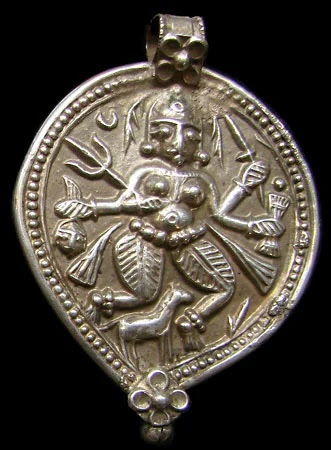
| Engraved Silver Lilith Pendant |
- The amulet is primarily made of silver.the technique used for this amulet was engraving
| Engraved Silver Lilith Pendant |
| Brass Durga Pendant |
![]() |
| Fodo Badge And Necklace With Resin Beads And Pendant photo:by Ayanda |
| Nazar Evil Eye The Nazar amulet, sometimes known as the Evil Eye amulet, is not the "Evil Eye." Instead, the Evil Eye is the expression that a person or supernatural being uses to express their envy of another. The eyes are thought to have supernatural abilities and act as the soul's entrance. The Greek word for the evil eye is (mati), which is believed to be a universal sign of protection. The evil eye is believed to be directed at someone who stares out of envy or distaste in order to bring them bad lucks. The evil eye is a talisman designed to keep you safe from these malicious spirits. The evil eye amulet is a protective symbol used to ward off the negative effects of the "evil eye," which is the belief that envy or dislike directed toward a person can bring bad luck upon them. This amulet serves as a talisman designed to shield individuals from the harmful influence of malevolent spirits associated with the evil eye. It is made of handmade glass. |
![]() |
| Etruscan gold bulla amulet |
The Roman bulla is a round amulet worn by boys to ward off evil spirits. It consists of two convex plates and is typically given to a boy eight days after his birth, coinciding with the day he is named. It also symbolizes the status of being a freeborn child.
Materials: The materials used to craft a Roman bulla varied depending on the family's status:
The Roman tradition of wearing bullae was influenced by the Etruscans, and it played a significant role in the cultural practices surrounding the birth and naming of children in ancient Rome.
| Beaded Catholic Rosary |
eating a rosary involves stringing the beads together in a specific pattern, often with a crucifix or cross at one end and a pendant or centerpiece at the other. Skilled artisans carefully knot or attach each bead to the cord
![]() |
| Heavy beaded neck piece with with a crescent front |
![]() |
| Egyptian Ankh |
In Ancient Egypt, the ankh symbol, often referred to as the "key of life" or "key of the Nile," held deep spiritual significance, symbolizing eternal life. This unique cross, believed to be the earliest of its kind, was crafted by Africans in ancient Egypt. The ankh frequently appeared in the hands of revered Egyptian figures like pharaohs and rulers, serving as a symbol of their immortality, the ability to live eternally. It was both worn by the living and often represented in temples and held by Egyptian deities such as Osiris, Isis, and Ra. Ankhs were placed within mummy wrappings to ensure the deceased's rebirth and well-being in the afterlife. They were commonly incorporated into rings, bracelets, and necklaces. The ankh was a symbol representing the elements of water, air, and the sun, all essential for sustaining and preserving life. It was also traditionally placed within sarcophagi, symbolizing the assurance of life after death.
Ankhs were crafted using various materials, typically from metals like gold or precious materials like faience. They were meticulously designed and could be worn as pendants, rings, or other forms of jewelry. The technique involved careful artistry to create this symbol of profound spiritual and eternal significance.